
Nature's Time Capsules: What Are Geologic Concretions?
Have you ever been strolling a shoreline or wandering in the desert and spotted a rock that looked like a cannonball, a perfect sphere, or even a fossilized dinosaur egg? Well, chances are, you stumbled upon a concretion!
What is a Concretion?
A concretion is a hard, compact mass or aggregate of mineral matter. While many are somewhat spherical, they also frequently appear as disks, oblong shapes, or irregular masses.
How Do Concretions Form?
Unlike geodes, where crystals grow into empty spaces, concretions form around a centralized nucleus - typically organic matter such as a shell, bone, or vegetation (like leaves and organic debris).
As mineral-rich waters flow through porous sediment (like sand or mud), minerals begin to precipitate and harden around the nucleus. This acts like a "natural glue", cementing the sediments together. Over thousands or even millions of years, this "cement" grows outward in layers, creating a weather-resistant solid mass.
The example shown below of an Ammonite concretion is the perfect representation of how these fun geologic phenomena form. Below you can see the Ammonite shell peeking out of the hardened concretion, and the split shell inside!
From the exterior, it may look like an everyday common rock. But when cracked open, the fossil remains of an Ammonite shell are revealed! The shell acted as the perfect "nucleus" or center of the concretion.


Why Are Concretions So Round?
While they come in many shapes, the "cannonball" variety of concretion is the most famous. This occurs when minerals precipitate equally in all directions. If the surrounding sediment is uniform, the concretion grows into an almost perfect sphere. However, because environmental conditions vary, most concretions end up with a more oblong shape.
Concretions vs. Geodes: What's the Difference?
It's easy to get these two mixed up since both often have crystals inside, but the formation process is completely different.
Concretions grow outward from a centralized point, filling void spaces between sediment particles.

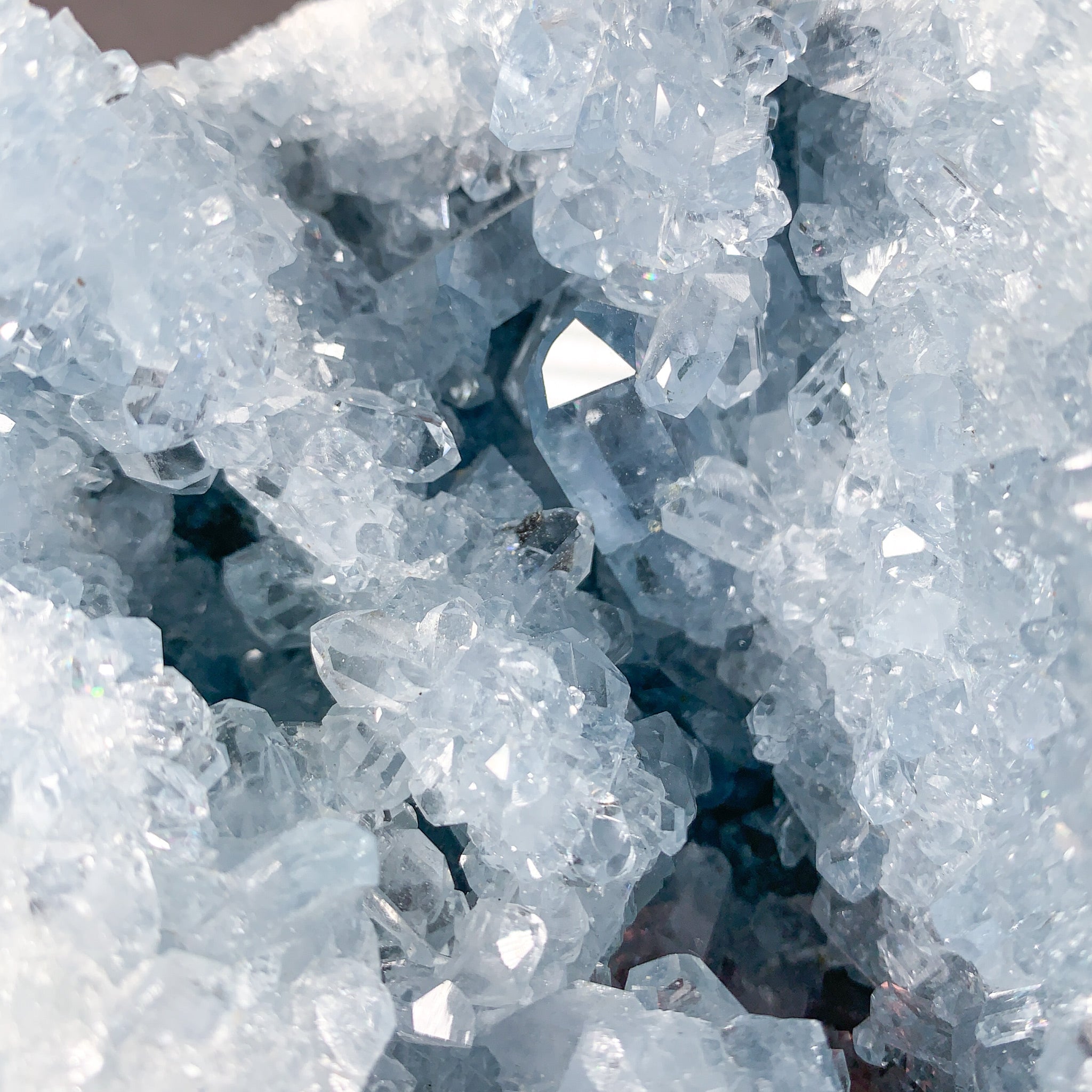
Geodes grow inward from the outside. They begin as a hollow cavity (like a gas or air bubble in a volcanic rock), and minerals crystallize on the interior walls, often leaving a hollow, crystal-lined center.

Conclusion
Concretions are incredible geologic "time capsules". Because the surrounding mineral "cement" hardens relatively quickly (geologically speaking), it often preserves delicate fossils that would otherwise get destroyed.

Whether they hide a cluster of crystals or a prehistoric shell, concretions are a fun geologic formation with treasures hiding inside.
Try adding one to your collection to celebrate the inner beauty of these creations.