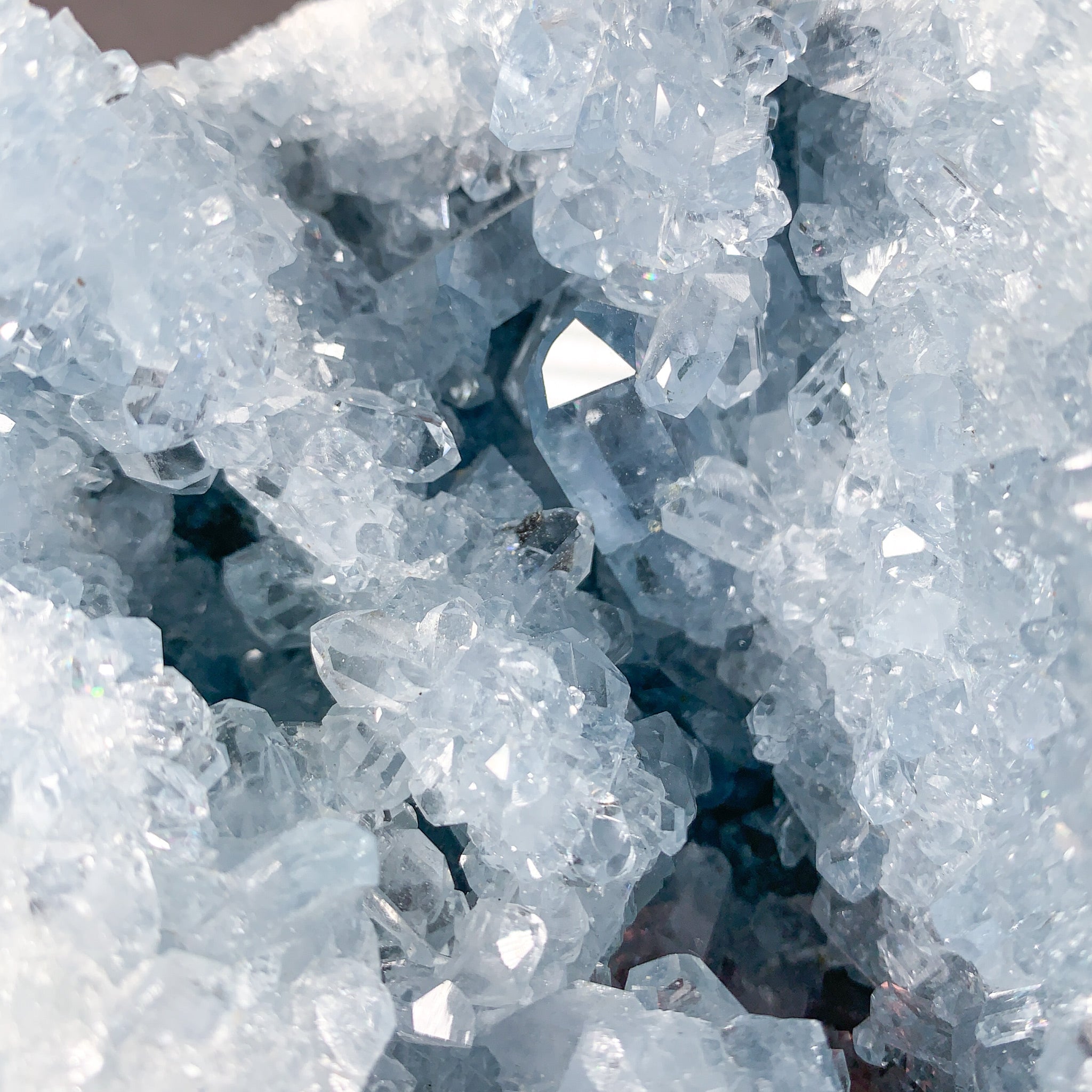

Rocks are categorized into three classes based upon their origin: Igneous rocks, Sedimentary rocks, and Metamorphic rocks. Each type is classified by its texture, structure, and the minerals it contains. Today we're exploring the "first" rock type, Igneous rocks!

Igneous Rocks
Igneous rocks form from molten rock (magma), or the hot aqueous solutions that emanate from it. The name igneous actually comes from the Latin "Ignis", meaning fire, referring to the molten rocks from which they form. Whether cooling deep underground or at the surface, igneous rocks tell an important story of the Earth's internal heat.
How do Igneous Rocks Form?
Magma which originates deep within the Earth, slowly moves upward and either cools before reaching the Earth's surface, or makes its way up and out through the Earth's crust. There are two main categories of igneous rocks based on where the magma cools: Extrusive and Intrusive.
Extrusive (Volcanic) Igneous Rocks
Extrusive igneous rocks form when magma reaches the Earth's surface. When magma is ejected or flows from the surface of a volcano or volcanic vent, it is called lava. When the lava has cooled into a solid, it is referred to as an extrusive igneous rock, or sometimes commonly called a "Volcanic" rock.
Basalt is the most common extrusive igneous rock.
Intrusive (Plutonic) Igneous Rocks
Intrusive igneous rocks, sometimes called plutonic rocks, form when magma cools and hardens inside the Earth, before reaching the surface. These rocks are typically coarser grained, with larger, visible crystals.
Granite is an example of an intrusive igneous rock.
Pro Tip: To remember the difference, think Extrusive = Exit (Exterior) and Intrusive = Inside (Interior).
Where do Igneous Rocks Form?
Igneous rocks form in a variety of geologic environments, but their location is nearly always driven by plate tectonics.
Temperatures of magma can range between 900 and 1600 degrees Celsius or nearly 1600 and 2900 degrees Fahrenheit! Due to its high heat, magma is quite fluid or viscous, allowing it to flow over and between surfaces and even create new landforms.
Divergent Plate Boundaries
As tectonic plates pull apart, pressure on the mantle decreases, causing it to melt (a process called decompression melting).
Mid-Oceanic Ridges
Along mid-ocean ridges where plates are diverging, the ridge line opens, allowing magma to rise up and fill the gap. As the magma cools into basalt, it creates new oceanic crust.
Continental Rifts
Tectonic plates that pull apart on land create volcanoes and lava (basalt) flows like those along the East African Rift.
Convergent Plate Boundaries
When tectonic plates collide, one is often forced underneath the other in a subduction zone. This action causes water, rocks and minerals to be carried down into the hot mantle. The water lowers the melting point of the surrounding mantle rock, creating magma through a process called flux melting.
Volcanic Island Arcs and Batholiths
The process of subduction causes magma to rise closer to the surface of the Earth, either forming volcanoes through extrusive igneous processes, or batholiths through intrusive igneous processes.
Batholiths are formed when the magma does not reach the Earth's surface, but remains trapped underground cooling into massive granite bodies.
Hot Spots
Occurring far from plate boundaries, Hot Spots or Mantle Plumes are a result of extreme heat rising up from deep within the Earth's mantle. As tectonic plates slowly migrate over these hot spots, chains of volcanoes, such as the Hawaiian Islands can form.
Types of Igneous Rocks
Oxygen (O) and Silicon (Si) are the most abundant elements in magma, so geologists classify igneous rock types based upon their silica (SiO2) content. The amount of silica dictates the rocks color and how "runny" or viscous the magma is.
Ultramafic
Ultramafic magma has a very low silica content, below 45%, with very high concentrations of Iron (Fe) and Magnesium (Mg). These rocks represent our closest understanding of rocks deep inside the Earth as they make up the majority of the Earth's mantle.
Olivine and Pyroxene both olive-green to dark green-black minerals are common. Typically ultramafic rocks are not found on the Earth's surface because they form very deep underground.
This type of magma requires extremely hot temperatures to form, much hotter than can be produced by typical volcanoes. Because of this, most ultramafic rocks we see on the surface are either from rocks that were essentially ripped off from rising basaltic magma and carried to the surface, or from eroded away surface rocks which produce a window into the interior of these ancient magma bodies.
Mafic
Mafic magma has silica content of about 50%, with high concentrations of Iron (Fe) and Magnesium (Mg). It typically has a lower viscosity (stickiness) or resistance to flow, meaning it's some of the most fluid of the magma types. It can move quicker once it reaches Earth's surface, and cools into Basalt. The high iron and magnesium content give mafic rock their darker color, typically black, dark gray, or dark green.
The Hawaiian Islands are a great example of mafic magma which has cooled into Basalt rock. Basalts often play host to some amazing minerals! The air and gas bubbles the rock contains creates the perfect void spaces for later stage hydrothermal fluids to crystallize.

Intermediate
Intermediate magma has a slightly higher silica content, around 60%. They typically contain Magnesium (Mg) and Iron (Fe). Intermediate magmas have a higher viscosity, which means it is more sticky and has a higher resistance to flow. It tends to build up pressure below the Earth's surface and is released more explosively or violently. It tends to be a mix of lighter and darker colored minerals, giving it an almost salt and pepper appearance such as the rock Diorite.
As these intermediate magmas cool, they form a rock called Andesite. In fact, the Andes Mountains of South America are actually named for their rock type, Andesite!
Felsic
Felsic magma has the highest silica content of all the other magma types at around 65 to 70%. They are typically rich in Aluminum (Al) and Potassium (K). Due to the high silica content, it has the highest viscosity, which means it is very resistant to flow. The thick, sticky magma causes gas bubbles to be trapped within a volcano's magma chamber, causing very violent and explosive eruptions.
Lava that is ejected violently from these felsic magmas cools into Dacite and Rhyolite rock. The felsic rocks tend to be lighter in color such as white, pink or light gray stones such as Granite.
Rhyolite is the fine-grained, extrusive igneous rock equivalent of Granite (intrusive igneous rock).
In summary:
Mafic Magma: Low viscosity (runny) and flows easily like the lava in Hawaii.
Felsic Magma: High viscosity (stick) and traps gas bubbles leading to violent and explosive eruptions.
Characteristics of Igenous Rocks
The size of crystals in a rock can be a sort of "thermometer" as to how fast it cooled.

Fine-grained (aphanitic) extrusive igneous rocks have tiny crystals visible only under a microscope. When lava erupts onto the surface of the Earth as extrusive igneous rocks, it tends to cool very quickly. In fact, cooling and hardening can occur in a matter of days or weeks! Because of this rapid cooling, crystals do not have adequate time to develop. Fine-grains indicate rapid, extrusive cooling. An example of this type of rock is Basalt or Pumice.
Coarse-grained (phaneritic) intrusive igneous rocks have larger crystals visible to the naked eye. This indicates slow, intrusive cooling. An example of this type of rock is Granite.
Porphyritic rocks have large crystals called Phenocrysts which are embedded in a fine-grained matrix. This happens when magma starts cooling slowly below the Earth's surface and then erupts violently.
Glassy extrusive igneous rocks have no crystals at all! This happens when lava cools quickly as it reaches the surface. When lava is cooled within a matter of hours, or so quickly that no crystals have time to form at all, it is called Volcanic Glass. An example of this rock type is Obsidian.
Minerals Found in Igneous Rocks
There are several key elements found in magma, including Oxygen (O), Silicon (Si), Aluminum (Al), Iron (Fe), Calcium (Ca), Magnesium (Mg), Sodium (Na), and Potassium (K). Considerable amounts of water (H2O) and carbon dioxide (CO2) are also present.
As the magma beings to cool whether inside or outside the Earth, an ordered crystallization of minerals occurs.
Each mineral crystallizes at a different temperature. A petrologist named Norman Bowen developed the Bowen's Reaction Series. This series depicts how minerals crystallize in sequence from highest to lowest temperatures.
Minerals with the highest melting point will cool or solidify first, including Olivine or Peridot (Mg2SiO4). As the magma solution continues to cool, crystallization will occur over a series of temperatures.
Common minerals found in igneous rocks include Quartz, Feldspar, Micas, Olivine and Labradorite.
Fun Fact: The air and gas bubbles present in basalt are the perfect spaces for minerals to crystallize. Beautiful minerals like Amethyst, Apophyllite, Stilbite and other minerals can often be found in these void spaces.

Conclusion
Igneous rocks are the fiery foundation of volcanoes and even some mountain ranges! They also play host to some of our favorite minerals! We hope you enjoyed learning about this amazing rock type.