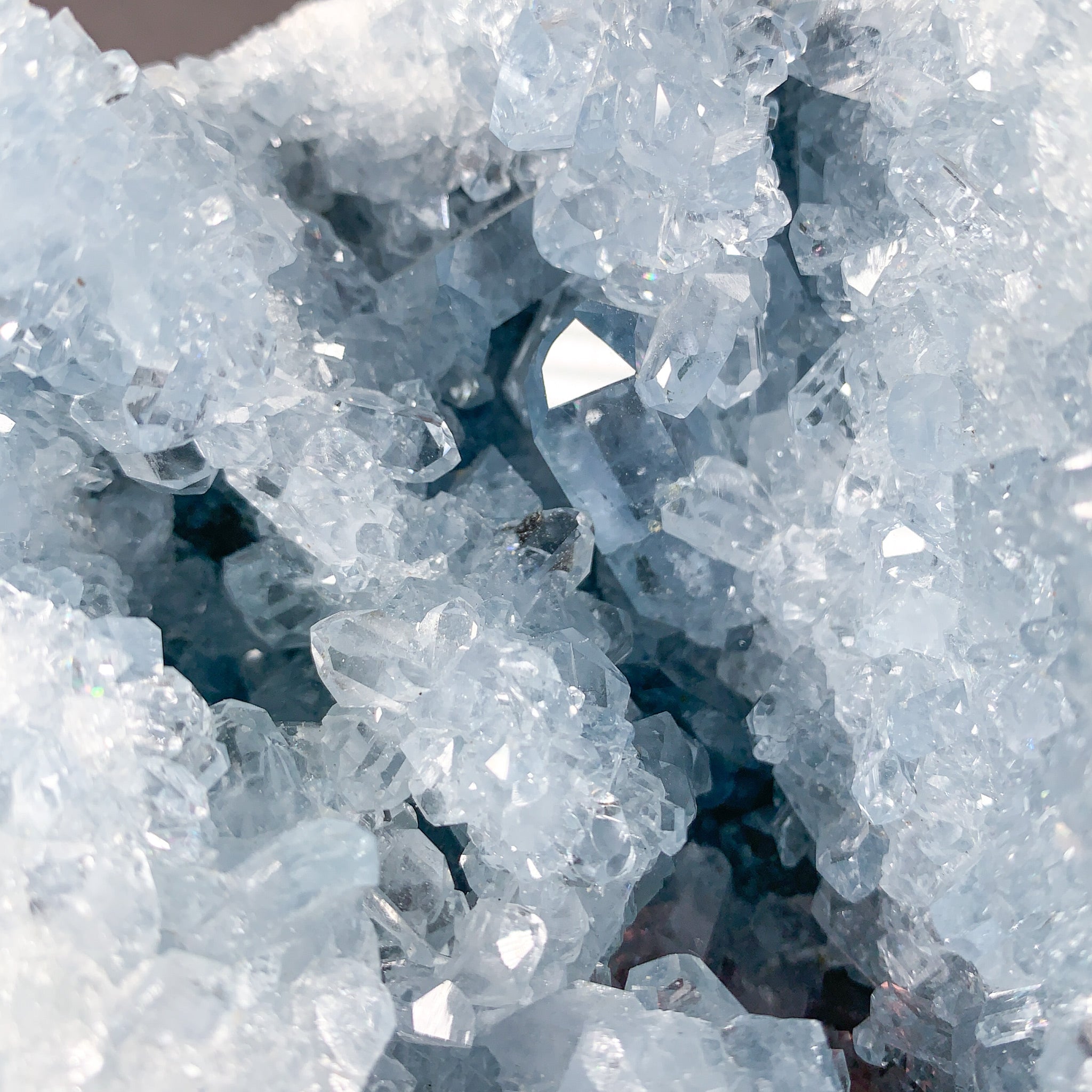

Rocks are categorized into three classes based upon their origin: Igneous rocks, Sedimentary rocks, and Metamorphic rocks. Each type is classified by its texture, structure, and the minerals it contains. Today we're exploring Sedimentary rocks!
Sedimentary Rocks
Sedimentary rocks are rocks that form through the accumulation and solidification of sediments. They can be composed of minerals, fragments of rocks, or even animal and plant matter! Sedimentary rocks often contain visible layers called strata, and play host to one of our favorite formations, fossils!
The name sedimentary comes from the Latin "sedimentum" which means a "settling".

(Our puppy dog Indy doing some settling of his own)
How do Sedimentary Rocks Form?
Sedimentary rocks form as sediments accumulate and exert pressure on lower beds, causing the compaction and cementation into rock layers.
As sediments build up, they are buried progressively deeper, until the weight of the overburden creates enough pressure to squeeze out moisture and further compact the sediments together, hardening into rock.
Even the heat from the Earth's interior can cause layers of sediment to turn into solid rock through a process called lithification.
For example: Accumulation of grains of sand eventually compact and cement together to form sandstone. Finer grain material like mud will compact to form mudstone or shale.
Types of Sedimentary Rocks
There are three main categories of sedimentary rocks including clastic, organic, and chemical.
Clastic Sedimentary Rocks
Clastic sedimentary rocks form from fragments (clasts) of pre-existing rocks and minerals that have broken down over time due to weathering. These pieces of older rocks are transported by mechanical agents like water (rivers, waves, rain), ice (glaciers / freeze thaw), wind, and gravity (avalanches, landslides) to another location where they accumulate and are deposited.
Conglomerates, sandstones and shales are examples of clastic sedimentary rocks and are often composed of the minerals Quartz, Feldspar and Mica.
Because clastic sedimentary rocks form from fragments of pre-existing minerals and rocks that have been broken down over time by weathering, their composition is typically similar to that of the original or parent rock.
For example: A sandstone composed of quartz and feldspar grain likely was derived from a coarse-grained igneous rock like granite.
As fragments of rocks and minerals get transported, they are tumbled, jostled around, and tend to break apart into progressively smaller and smaller pieces. For this reason, harder minerals tend to survive the journey better than softer minerals. That is why you typically see grains of sand composed of harder minerals like Quartz.
Placer Deposits
Placer deposits are the most economically important type of sedimentary rock deposits. When rocks are broken down by the weathering processes mentioned above, they are transported as part of the gravels and sands in creek beds, streams, rivers and landslides. Heavier metals and minerals can be transported along with other sediments, and deposited far downstream or downhill from the original source rock.
As these sediments become to heavy for the water or gravity to continue to transport, finer grains stay suspended in solution and the heavier material like gold is deposited in a concentrated area called a placer deposit.
This is why stream beds and valley floors far away from mountainous hillsides are often dredged for precious metals like gold!
Minerals such as garnets, diamonds, rubies, sapphires, and gold have all been discovered in clastic sedimentary rocks and placer deposits.
Organic (Biogenic) Sedimentary Rocks
It may sound crazy that rocks can form from previously living organisms, but that's exactly what happens with organic sedimentary rocks! Organic sedimentary rocks form directly or indirectly through plants or animals.
For example, living corals excrete a type of mineral called calcium carbonate (CaCO3). This may look familiar to you, because that's the same chemical formula as the minerals Calcite and Aragonite!

(Exterior of a fossilized coral)
That means that once the coral gets buried by sediments, the remains can be converted into a sedimentary rock like limestone. Fossils are very common in this type of formation.
Chemical Sedimentary Rocks
Chemical sedimentary rocks consist of rock composed of minerals produced by precipitation from saline or freshwater solutions. If the solution becomes concentrated enough, it will precipitate minerals such as calcium carbonate stalactites and stalagmites in caves.
Sedimentary rocks can also form through evaporation, where mineral-rich waters evaporate, leaving behind evaporite deposits like gypsum / selenite or salt deposits like halite that are turned into chemical sedimentary rock.

(Halite crystals)
Characteristics of Sedimentary Rocks
Identifying sedimentary rocks is typically very easy due to the obvious bedding planes, layers, ripple marks, cross-bedding, mud cracks, and above all else, the presence of fossils. But the most common characteristic to distinguish the types of sedimentary rocks are the grain sizes.

(Layers of Sandstone)
Coarse-grained
Sedimentary rocks which have sediments coarser than sand such as pebbles and boulders is considered coarse-grained. These types of rocks tend to get deposited closer to the original source rock, as the material is too large or heavy to be carried further distances by natural sources. Conglomerate is an example of a coarse-grained sedimentary rock.
Medium-grained
Sedimentary rocks which have sediments that are the size of sand grains are considered medium-grained. This material tends to be deposited near shorelines, as heavier Quartz grains get deposited. Sandstone is an example of a medium-grained sedimentary rock.
Fine-grained
Sedimentary rocks which have sediments finer than a grain of sand such as silts, clay and muds are considered fine-grained. Finer grains and clay particles can be carried further away from shore, and are deposited the greatest distance away from the source rock. Shale is an example of a fine-grained sedimentary rock.
Minerals Found in Sedimentary Rocks
The most common minerals found in sedimentary rocks are Anhydrite, Aragonite, Calcite, Celestite, Dolomite, Gypsum / Selenite, Halite, Marcasite, and Pyrite. More rare minerals like Gold and the Platinum group can also be found in placer deposits of sedimentary rocks.
It is important to note, that the minerals listed above are not exclusive to sedimentary rock types, but they can often be found there.

(Calcite crystal)
Fossils Found in Sedimentary Rocks
Sedimentary rocks are where our favorite fossils can be found! It would be extremely rare to find a fossil in an igneous rock, and nearly impossible in metamorphic rocks due to the high heat and pressure these rocks undergo during formation, essentially "melting" any fossils present.
Fossils found in sedimentary rocks play an important role for geologists to determine what type of environment the organisms lived in during ancient times. Geologists can also use the age of fossils to determine the age of a rock layer and vice versa.

(Ammonite fossil in a shale matrix)
Conclusion
Sedimentary rocks are an important part of our geologic world and play host to our favorite fossils! We hope you enjoyed learning about this fun rock type.