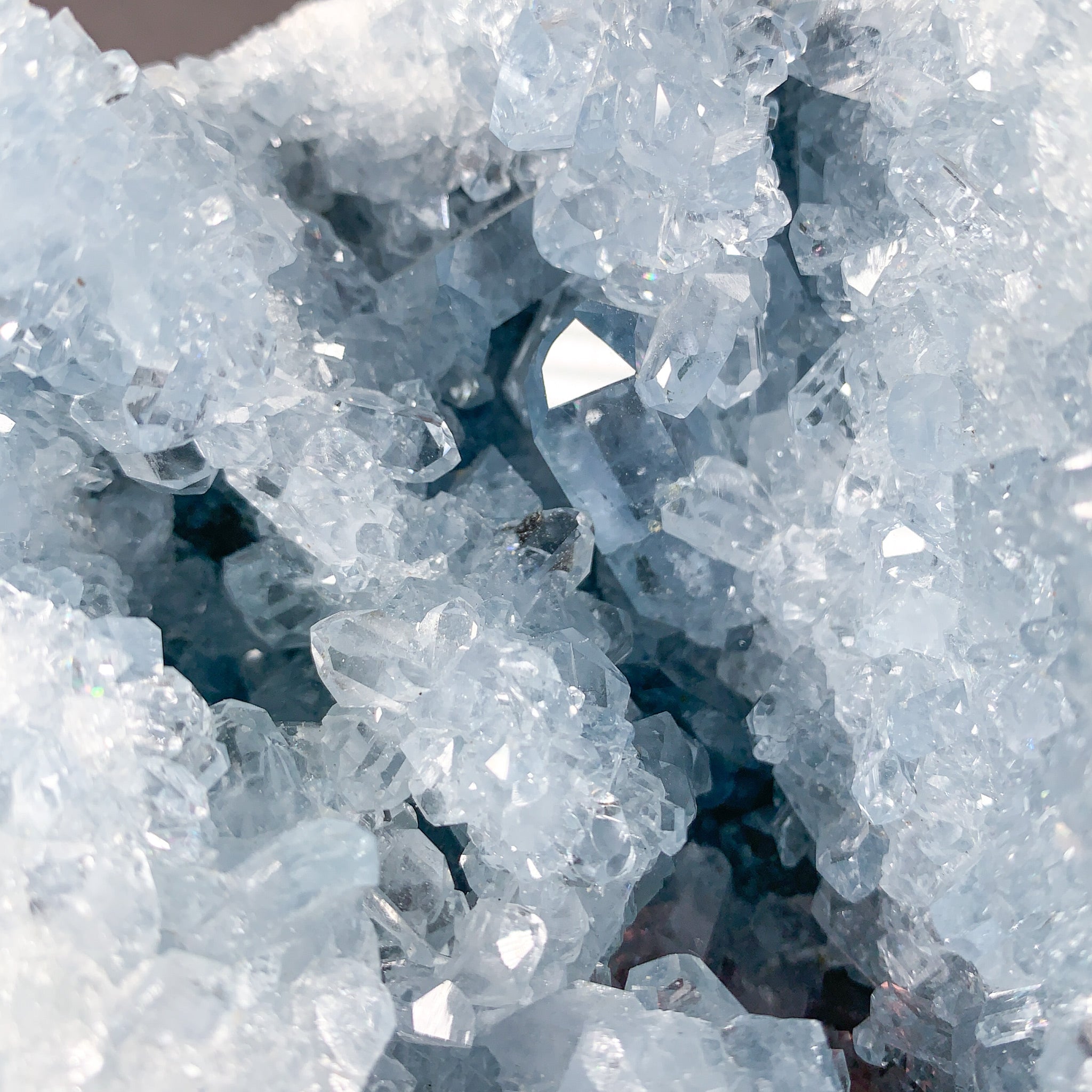

Rocks are categorized into three classes based upon their origin: Igneous rocks, Sedimentary rocks, and Metamorphic rocks. Each type is classified by its texture, structure, and the minerals it contains. Today we're exploring Metamorphic rocks!
Metamorphic Rocks
Metamorphic rocks form when pre-existing "parent" rocks undergo changes from intense heat and pressure deep within the Earth. The term metamorphism comes from the Greek 'meta' meaning change, and 'morphos' meaning form.
The pre-existing rock, also called protolith (proto = first, and lithos = rock), that gets metamorphosed can be igneous, sedimentary, or even older metamorphic rock.
During metamorphism, mineral grains may change size or shape, new structures may form in the rock, and entirely new minerals can form!

(Blue Kyanite with Quartz and Staurolite)
How do Metamorphic Rocks Form?
Metamorphic rocks are essentially "cooked" under extreme conditions. As rocks are subducted or buried deep underground, they encounter the geothermal gradient - the deeper you go, the hotter it gets.
It's important to note that while these rocks get super-heated and pressurized, they never actually melt. If a rock melts completely, it becomes magma and will eventually cool into an igneous rock. Metamorphism happens entirely in a solid state.
Under these conditions, minerals often become more crystalline, with grains elongating and aligning in distinct layers. In rocks that have undergone extreme pressure, you will often see these mineral layers folded or bent in an organized fashion.

(Black Kyanite crystal cluster)
The Two Pillars of Change: Heat & Pressure
High Temperatures
Metamorphism typically occurs between 200 degrees Celsius and 700 degrees Celsius (approx. 400 degrees to 1,300 degrees Fahrenheit). In this "sweet spot", mineral constituents undergo chemical reactions and can recrystallize via small amounts of fluids (like water or steam) without the rock losing its solid structure.
High Pressures
Metamorphic rocks typically form at depths between 2 and 12.5 miles deep within the Earth (3 to 20 kilometers), creating an immense amount of pressure on the stone.
Types of Pressure
Lithostatic
At extreme depths, lithostatic or load pressure effects the rock equally on all sides, and from all directions. This causes chemical reactions to occur, just like from extreme heat, and allows new minerals to form.
Marble is limestone (a sedimentary rock), that has undergone metamorphism under lithostatic pressure.

(Metamorphosed Limestone which turned to Marble)
Directed
Directed pressure is an unequal balance of forces on a rock in one or more directions. This typically occurs at lower pressures, which does not generate chemical reactions or changes in the composition of minerals. Instead, it affects the parent rock by changing the arrangement, size and shape of the crystals.
You will often see foliated textures like those seen in schist and gneiss as a result of directed pressure.
Crystals can become rotated, become fractured, get reduced or enlarged in grain size.
Recrystallization can occur where minerals dissolve from an area of the rock experiencing high stress and precipitate or regrow elsewhere in the rock which is undergoing lower stress. This process also tends to increase crystal grain sizes, as constituents congregate to form larger crystals.
Where do Metamorphic Rocks Form?
In general, there are two main type locations where metamorphic rocks form, contact metamorphic rocks, and regional metamorphic rocks.
Contact Metamorphism
Contact metamorphism occurs in zones (aureoles) adjacent to hot intrusive igneous rocks, where the rocks come into "contact" with one another. If you remember from our Igneous rocks lesson, intrusive or plutonic igneous rocks are those that form from hot magma which rises from deep inside the Earth, but cools and crystallizes before reaching Earth's surface, such as a granite.
If, for example, a hot igneous intrusion starts to rise up from depths in the form of a narrow dike (an igneous intrusion that cuts into a host-rock), the zone of contact between the hotter dike and the cooler surrounding host rock can undergo contact metamorphism. This will "cook" or alter the rock around the zone of contact into new materials / stone, such as a granite gneiss.
Limestones in contact metamorphic zones turn to marbles, and Sandstones turn into Quartzites.

(Sandstone and Quartzite)
Regional Metamorphism
Regional metamorphism gets its name from larger scale metamorphic changes that occur as a result of mountain-building events or the deep burial of rocks. Large ranges that often undergo massive changes, folding and faulting are in these areas. This can occur over large distances, many hundreds of miles wide.
Where tectonic plates converge to create mountain ranges, rocks are crushed and sheared at depth, and can be metamorphosed by the heat from rising magma.
Regional Metamorphic rocks typically get grouped based upon the degree of metamorphism that occurs.
Low-grade metamorphism involves relatively lower pressures and temperatures, typically below 320 degrees Celsius / 608 degrees Fahrenheit. It typically produces rock such as slate, and low-grade chlorite-schist. The presence of Calcite, Biotite, Chlorite, Epidote, and Spessartine Garnet are a sign of low-grade metamorphism.
High-grade metamorphism involves relatively higher pressures and temperatures, typically above 500 degrees Celsius / 932 degrees Fahrenheit. It produces rocks like gneiss and high-grade schist. High-grade metamorphic minerals include Almandine and Grossular Garnet, Hornblende, and Kyanite.
Honorable Mention: Hydrothermal Metamorphism
While not as common as contact and regional metamorphism, hydrothermal metamorphism occurs on a much smaller scale. It occurs when hot gases and fluids are driven into fractures in the host rock, typically from intruding magmatic sources. This migrating fluid contains elemental constituents, and also picks up material from the surrounding host rock as it moves. Through this interaction and movement of fluids interacting with the surrounding host rock, new minerals and new rocks, particularly skarn type deposits and low-grade schists can form.
During the metamorphic process, as temperatures increase, water is generally lost from the rock. For example, a hydrous silicate clay stone like shale, will convert into slate with the increase in temperature and loss of water. If temperatures continue to increase, the slate can dehydrate and metamorphose further, turning into schist.
Types of Metamorphic Rocks
Metamorphic rocks can very broadly be characterized into foliated, and non-foliated (or granular) rocks.
Foliated Metamorphic Rocks
Foliated metamorphic rocks are characterized by their layered texture and foliations, which is a result of the intense compressional pressure within regional metamorphic areas.
Non-foliated (Granular) Metamorphic Rocks
Most non-foliated metamorphic rocks are composed of a single mineral, such as limestone (Calcite) metamorphosing to marble, or sandstone (Quartz) metamorphosing to quartzite. Typically, these form very close to the hot magma source of the contact zone of metamorphism.

(Bands of black Mica with Ruby in green Zoisite)
Minerals found in Metamorphic Rocks
Many amazing minerals can be found in Metamorphic Rocks. Listed below are the minerals you typically see associated with this rock type.
Actinolite
Apatite
Brucite
Chlorite
Diopside
Epidote
Felspar
Garnet (Almandine, Andradite, Grossular, Spessartine)
Hornblende
Kyanite
Labradorite
Mica (Biotite, Muscovite, Phlogopite)
Quartz
Ruby (Corundum)
Scapolite
Scheelite
Spinel
Staurolite
Tremolite
Vesuvianite
Zoisite

Conclusion
Metamorphic rocks are the survivors of the rock world. They underwent intense heat and pressure within the Earth and came out looking even more fabulous on the other side! We hope you enjoyed learning about this amazing rock type.